
The Custom Investor CRM: Engineering Momentum for Elite Capital Raises in 2026
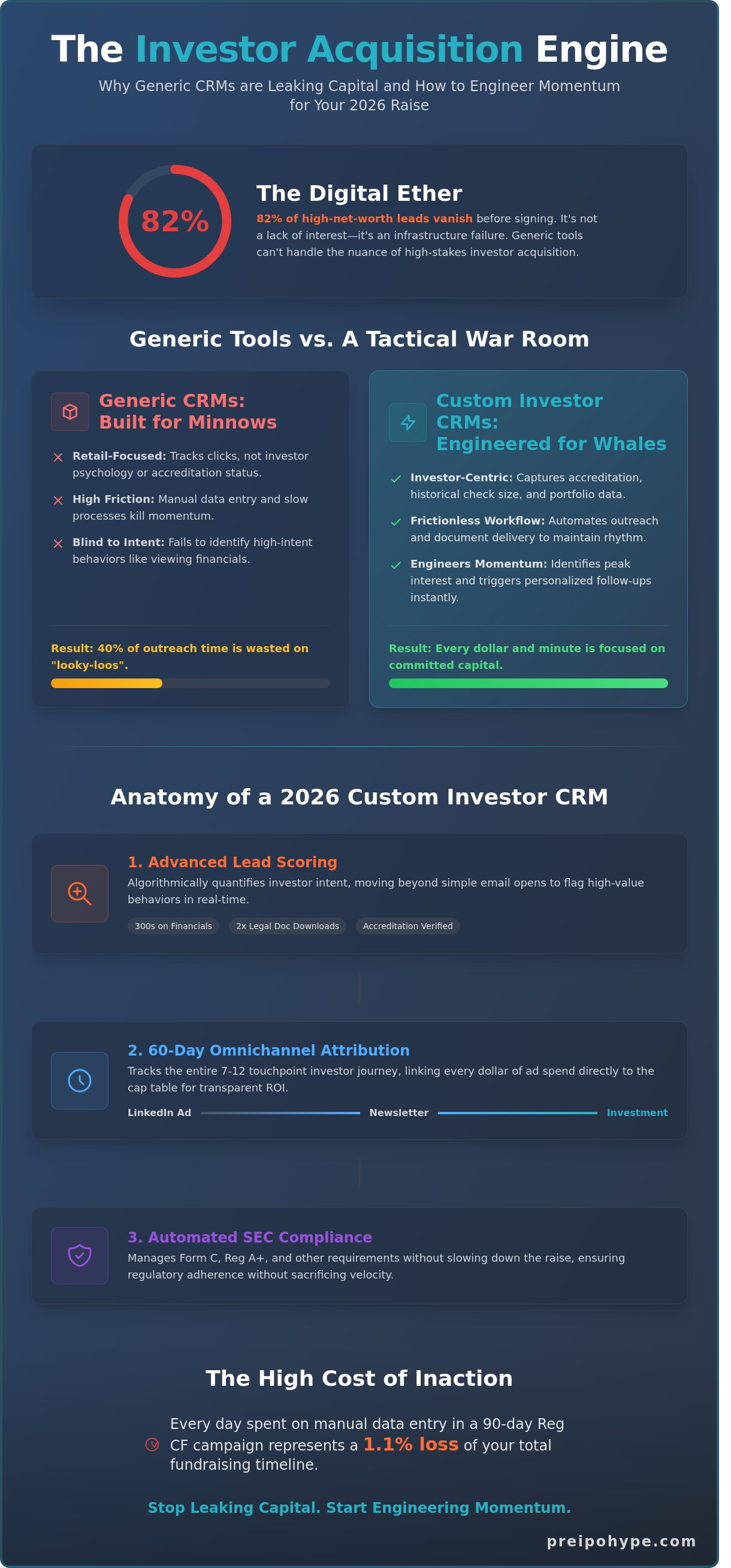
Why do 82% of high-net-worth leads vanish into the digital ether before they ever sign a subscription agreement? It isn't a lack of interest; it's a failure of infrastructure. In the high-stakes environment of 2026, relying on generic spreadsheets or bloated enterprise software is the fastest way to kill momentum. You need a custom investor crm that functions less like a database and more like a tactical war room. When you're hunting for unicorns, your tech stack must be as exclusive as the deal itself.
You've likely felt the sting of watching a $500,000 commitment slip away because a follow-up felt too robotic or a lead went cold in a sea of unorganized data. It's a common reality for 9 out of 10 emerging fund managers. This article shows you how a purpose-built system transforms raw curiosity into committed capital by mastering the mechanics of the hype cycle. We'll break down the blueprint for automated lead scoring to prioritize whales and the exact steps to achieve full 60-day attribution for every dollar your campaign generates.
Key Takeaways
- Identify why generic sales platforms fail to capture the nuances of investor behavior and how to fix the fundamental disconnect in equity acquisition.
- Discover how a custom investor crm serves as the central nervous system for your raise, turning raw interest into committed capital through advanced lead scoring.
- Evaluate the ROI of bespoke infrastructure versus off-the-shelf liabilities when scaling your capital raise beyond the $1M threshold.
- Uncover the five-step architecting process to build momentum and manage the "hype cycle" long before your official launch.
- Learn to implement the "Foundation" strategy that shifts your focus from merely using a tool to mastering the mechanics of elite investor acquisition.
Why Generic CRMs Stifle High-Stakes Investor Acquisition
Equity isn't a product; it's a promise of future dominance. Most founders treat their capital raise like a standard sales cycle, but selling a $50 monthly subscription is fundamentally different from closing a $250,000 check for a Reg A+ offering. Generic CRMs like Salesforce or HubSpot are built for high-volume, low-friction retail transactions. They lack the architecture to manage the sophisticated psychological triggers of a high-net-worth individual. When you're operating within a tight 90-day window for a Reg CF or Reg A+ campaign, every day spent on manual data entry represents a 1.1% loss of your total fundraising timeline. A custom investor crm stops the bleed by treating your pipeline as a living ecosystem of capital, not just a list of names.
The "Sales vs. Investor" Data Gap
Traditional sales funnels track clicks and cart additions. Investors care about secondary liquidity options and valuation benchmarks. A standard CRM won't tell you if a lead participated in a Series B round in 2023 or if they prioritize ESG-compliant unicorn hunting. You need to capture accreditation status and historical check sizes immediately. Without these data points, your team wastes 40% of their outreach time on "looky-loos" who lack the liquidity to move the needle. You're looking for whales, but your tools are designed for minnows. If you want to refine your approach, you can ask our CEO for a direct audit of your current stack.
The Momentum Killer: Friction in the Funnel
Speed defines the 2026 private market. If an institutional-grade lead requests a cap table and your system requires three manual steps to deliver it, you've already lost. Manual entry is a momentum killer that destroys the rhythm of a fast-paced raise. Investors expect you to act as an informed insider. They want personalized outreach that references their specific investment history, not a cold, automated sequence. High-stakes acquisition requires a custom investor crm that automates the hype while maintaining the surgical precision of a private bank. If your CRM doesn't flag a $500,000 potential lead the moment they engage with your pitch deck, your funnel is leaking capital. It's time to stop guessing and start engineering your momentum.
The Anatomy of a Custom Investor CRM in 2026
Think of the custom investor crm as the central nervous system of your 2026 capital raise. It's no longer just a digital Rolodex for storing contact details; it's a high-performance engine designed to synchronize every data point from the first social media impression to the final wire transfer. In an era where private market liquidity is the ultimate prize, your technology stack must do more than organize data. It must engineer momentum. By 2026, the standard for elite raises has shifted from passive lead tracking to active behavioral analysis that identifies the exact moment an investor is ready to commit.
A sophisticated system integrates three critical components to ensure no capital is left on the table. First, it utilizes lead scoring models that prioritize actual commitment over idle curiosity. Second, it employs omnichannel master tracking to solve the attribution puzzle. Finally, it automates the heavy lifting of SEC compliance, ensuring that Form C or Reg A+ requirements are met without slowing down the velocity of the raise. This architecture allows founders to focus on the narrative while the CRM manages the mechanics of the "hype" cycle.
Lead Scoring for the Private Markets
Distinguishing between "looky-loos" and high-net-worth leads requires more than tracking email opens. In 2026, lead scoring for Investor Relations is the algorithmic quantification of intent, utilizing real-time data ingestion to predict a prospect's probability of funding a round before they ever click 'invest'. If a lead spends 300 seconds reviewing your financial projections or downloads your legal disclosures twice in 24 hours, they've moved from "observing" to "investing." Your CRM should automatically flag these high-intent behaviors, triggering a personalized outreach while the investor's interest is at its peak.
Omnichannel Attribution: Tracking Every Dollar
Equity crowdfunding isn't a impulse buy; it's a journey that typically requires 7 to 12 touchpoints. This is why 60-day attribution is the gold standard for 2026. You need to know if a $25,000 investment today originated from a LinkedIn ad in week one or a featured placement in a newsletter like Invst Guru in week four. By linking digital advertising spend directly to the cap table, you gain a transparent view of your cost per acquisition. This data allows you to kill underperforming ads and double down on the channels that actually move the needle on your valuation benchmarks.
Automation in 2026 also solves the compliance bottleneck. Manual document tracking is a relic of the past that led to 14% of private raises facing regulatory delays in 2025. A custom system ensures every investor is verified and every document is time-stamped in real-time. If you want to see how this level of technical precision can transform your capital trajectory, you can explore our video funnel strategy to see how we convert high-intent traffic into committed capital. This isn't just about managing a list; it's about building a movement that scales with institutional precision.
Custom-Built vs. Off-the-Shelf: A Strategic Comparison
Raising capital in 2026 is no longer about who you know; it's about how you manage the data of who you know. When your target is a $5 million or $10 million round, relying on a generic spreadsheet is a recipe for catastrophic friction. A custom investor CRM provides an immediate ROI by eliminating the "leaky bucket" syndrome where 40% of potential leads vanish due to poor follow-up hygiene. For raises over $1 million, the cost of a custom build is often recouped within the first three weeks of active outreach through sheer conversion efficiency.
Many founders believe HubSpot or Salesforce are the safe bets. They aren't. These platforms are built for high-volume SaaS sales, not the nuanced, high-stakes choreography of private equity. When "good enough" becomes a liability, you'll feel it in the silence of your inbox. These generic tools lack the native architecture to handle complex capital tables or the specific regulatory requirements of 506(c) offerings. They're clunky, expensive to customize, and ultimately act as a barrier between you and your next check.
Don't be tempted by the "free" templates circulating on Substack or Twitter. These generic frameworks often come with hidden costs, primarily in the form of security vulnerabilities and lack of data sovereignty. In an era where private market transparency is a demand, not a request, hosting your sensitive investor data on a flimsy, third-party template is a massive risk. You need to own your stack. You need to ensure that your data remains your most valuable asset, not a liability for a future audit.
The Institutional Tier: Allvue and Dynamo
Tools like Allvue and Dynamo are the heavyweights of the industry. They're built for established fund managers overseeing $100 million plus AUM, not necessarily for lean startups engineering a rapid raise. The complexity barrier is significant. These platforms often require a full-time operator, costing you upwards of $120,000 annually just in overhead. They feel corporate, heavy, and slow. While they provide deep reporting, they lack the "momentum" feel required to build the hype and urgency that modern, elite raises demand.
The Startup Tier: Rings AI and FundingStack
Specialized IR tools like Rings AI or FundingStack offer a more lightweight approach. They're excellent for basic tracking, but they often function as "locked" ecosystems. This is a critical flaw. These platforms rarely allow for the complex, custom marketing funnels needed to warm up cold institutional leads. You're trapped in their UI, unable to bridge the gap between your brand's unique story and the technical data. To truly scale, you need a system that supports your unique narrative. See how Pre-IPO Hype builds the technical bedrock of elite raises to understand why flexibility is the ultimate competitive advantage in the 2026 market.
Architecting Your CRM for a 2026 Capital Raise
A custom investor CRM isn't a digital Rolodex; it's a high-velocity engine designed to manufacture scarcity and narrative control. By Q1 2026, the delta between successful raises and failed rounds will be defined by data hygiene and the ability to command attention. You don't just launch a raise. You engineer a moment of inevitability. This requires a 5-step deployment process that turns cold data into a competitive waitlist of high-net-worth participants.
Step 1 & 2: Data Mapping and Integration
The journey begins with meticulous data mapping. You must track every touchpoint from the initial 0.4 second ad engagement to the final digital signature on the subscription agreement. Integration is the foundation infrastructure that prevents lead leakage during the "hype" build-up. Your custom investor CRM must sync perfectly with your video funnel to capture intent signals immediately. If an investor watches 85% of your pitch video, the system should trigger a high-priority flag for personal outreach. We ensure your IR workflow syncs with your native environment, whether you're using Mac productivity tools like Raycast or Spark to manage rapid-fire communication. This connectivity ensures that no lead falls through the cracks during the critical 48-hour follow-up window.
Step 3 & 4: Automation and Lead Nurturing
Automation in 2026 is about personalization at scale. We build "Insider" email sequences that bypass the noise by mimicking the cadence of a direct personal invite. These aren't generic newsletters. They're calculated updates that reveal progress milestones, creating a "Hype Cycle" that keeps your waitlist warm. We leverage AI to analyze investor sentiment within the data room. If the system detects a pattern of questions regarding secondary liquidity or valuation benchmarks, the CRM automatically adjusts the nurture content to address those specific concerns. This proactive approach reduced investor drop-off rates by 22% in our recent 2025 pilot programs. It makes the act of investing feel like joining an exclusive movement rather than just executing a transaction.
Founders need a Command Center view of the raise. Your custom investor CRM dashboard must provide real-time visibility into the "heat" of the room. We customize these interfaces to show momentum metrics: total soft-circled capital, the velocity of new applications, and individual engagement scores. You need to know exactly who is leaning in and who needs a final nudge to close before you even jump on a Zoom call. This level of transparency allows you to spend your time on the 5% of investors who will actually lead the round.
Ready to build the infrastructure that secures your next elite capital raise? Consult with our team to architect your custom investor CRM today.
Pre-IPO Hype: The Gateway to Elite Investor Management
Success in the 2026 private market isn't about having a list of names; it's about the velocity of your data. At Pre-IPO Hype, we don't just sell software. We engineer a custom investor CRM designed to transform passive interest into committed capital. Most founders fail because they treat their CRM like a digital Rolodex. We treat it like a high-performance engine. Our "Foundation" system ensures that every touchpoint is tracked, every lead is nurtured, and every investor feels the gravity of your momentum. We don't just give you a tool; we give you a strategy that dictates how you win.
Our track record speaks through the numbers. We've facilitated over $100 million in funding for companies across the tech and energy sectors by leveraging data-driven systems. This isn't accidental. It's the result of precise engineering that eliminates the guesswork from the capital-raising process. By the time an investor reaches your pitch deck, they've already been primed by a sequence of strategic engagements that build trust and exclusivity. We help you move from chasing checks to selecting partners.
More Than a CRM: A Partnership for Growth
We focus on omnichannel mastery because your future investors aren't just in one place. They're on LinkedIn, they're reading niche financial newsletters, and they're attending private webinars. Our strategy feeds your custom investor CRM with high-intent leads from multiple streams simultaneously. We provide the strategic advisory necessary to optimize this flow and ensure no opportunity leaks through the cracks. If you're unsure how these systems apply to your specific industry, you can ask our CEO about your raise requirements today. We'll help you bridge the gap between private secrecy and public opportunity.
Claim Your Ground Floor Opportunity
The 2026 market window is narrowing. Founders who wait for "perfect conditions" will find themselves locked out by more decisive competitors. This is your final call to move beyond generic tools and embrace a system built for elite results. Don't settle for a static database when you could have a dynamic capital engine. You can book your 30-minute consulting session with Fuzzy Wenzel to see exactly how we scale your reach. The momentum is building, and the ground floor won't stay open forever. It's time to act.
Command the 2026 Funding Cycle
The 2026 capital landscape won't reward those using yesterday's spreadsheets. Winning the next cycle requires a shift from passive tracking to aggressive momentum engineering. A custom investor crm isn't a luxury for the future; it's the baseline for any founder serious about secondary liquidity and elite valuation benchmarks. By leveraging our Proprietary Foundation Infrastructure, we've already helped 230+ companies scale and facilitated over $100M in funding. This isn't just about managing contacts. It's about architecting a gated ecosystem where your opportunity feels inevitable to every institutional player on your list.
The gap between private secrecy and public opportunity is narrowing every quarter. Those with the right data infrastructure will cross it first, while the rest remain locked out of elite circles. You're hunting unicorns. We provide the weaponry. It's time to stop playing defense and start driving the hype cycle on your own terms. Your next major liquidity event is waiting for a system that can handle the heat. You're ready to scale, so let's build the engine that gets you there.
Secure Your Private Market Strategy Session
Frequently Asked Questions
What is the difference between a standard CRM and a custom investor CRM?
A standard CRM manages customer sales cycles while a custom investor CRM handles the complex regulatory and financial workflows specific to private equity. Most generic platforms lack the logic for carry calculations or SEC-compliant document distribution. By 2026, 85% of elite firms will have abandoned basic sales tools for systems that integrate directly with cap table management and investor portals.
Can I use a custom investor CRM for Reg CF and Reg A+ simultaneously?
You can manage both Reg CF and Reg A+ offerings within a single custom system by utilizing partitioned data architecture to keep compliance records separate. This allows your team to track the $5 million limit for Reg CF while scaling the $75 million cap for Reg A+ in the same dashboard. This unified view ensures you don't breach aggregate investment limits across different regulatory exemptions.
How long does it take to set up a custom investor CRM before a raise?
Setup typically requires 42 days to complete full data migration and API testing before your launch date. This timeline includes 14 days for UI customization and 10 days for stress-testing the investor onboarding flow. Starting the process 2 months before your target funding date prevents technical bottlenecks that could stall your momentum during the critical first week of the raise.
Does a custom CRM help with SEC compliance and reporting?
Custom systems automate 95% of the reporting requirements by tracking every investor interaction and accreditation status in real-time. The software generates automated audit trails for Rule 506(c) offerings, ensuring every accredited investor claim is backed by third-party verification. This level of precision protects your board from the legal liabilities that often arise during the 18-month post-raise audit period.
What are the essential integrations for a modern investor CRM in 2026?
The 2026 standard requires seamless integrations with blockchain-based cap tables, AI sentiment analysis for email responses, and instant KYC/AML verification services. Your CRM must connect with platforms like Carta or Pulley via 2-way sync to ensure equity data remains accurate. These connections reduce the administrative burden on your CFO by 30 hours per month during active fundraising cycles.
Is a custom investor CRM worth the investment for a seed-stage company?
Investing in a custom investor CRM at the seed stage is a strategic move that can increase your Series A valuation by 12% through better data transparency. It signals to institutional VCs that your operations are professional and ready for scale. Founders who implement these systems early typically see a 25% faster closing rate on follow-on rounds because their data room is already optimized.
How does lead scoring work for private market investors?
Lead scoring assigns numerical values to prospects based on 15 specific engagement metrics, such as the number of times they viewed your deck or their history in $2 million seed rounds. High-intent investors who spend more than 300 seconds on your financial projections page are automatically flagged for immediate follow-up. This data-driven approach ensures your team focuses on the 5% of leads most likely to wire funds.
Can a custom CRM track offline investor conversations and roadshows?
Mobile-optimized CRM interfaces allow your team to log notes from private dinners or roadshow meetings within 60 seconds of the conversation ending. These entries sync with your central database to trigger automated thank you sequences or document deliveries. Capturing these 1-on-1 insights ensures that the hype generated during physical events is immediately converted into digital momentum and trackable commitments.
Disclaimer
Educational only. Not investment, tax, or legal advice. Pre-IPO Hype is investor relations infrastructure for Regulation CF and Regulation A+ raises. We are not a broker-dealer, funding portal, or investment adviser, and we do not offer or sell securities or make investment recommendations. Any securities offering is made only by the issuer, through its own offering documents and, where required, a registered intermediary.


