
The 2026 Investor CRM Playbook: How to Manufacture Fundraising Momentum
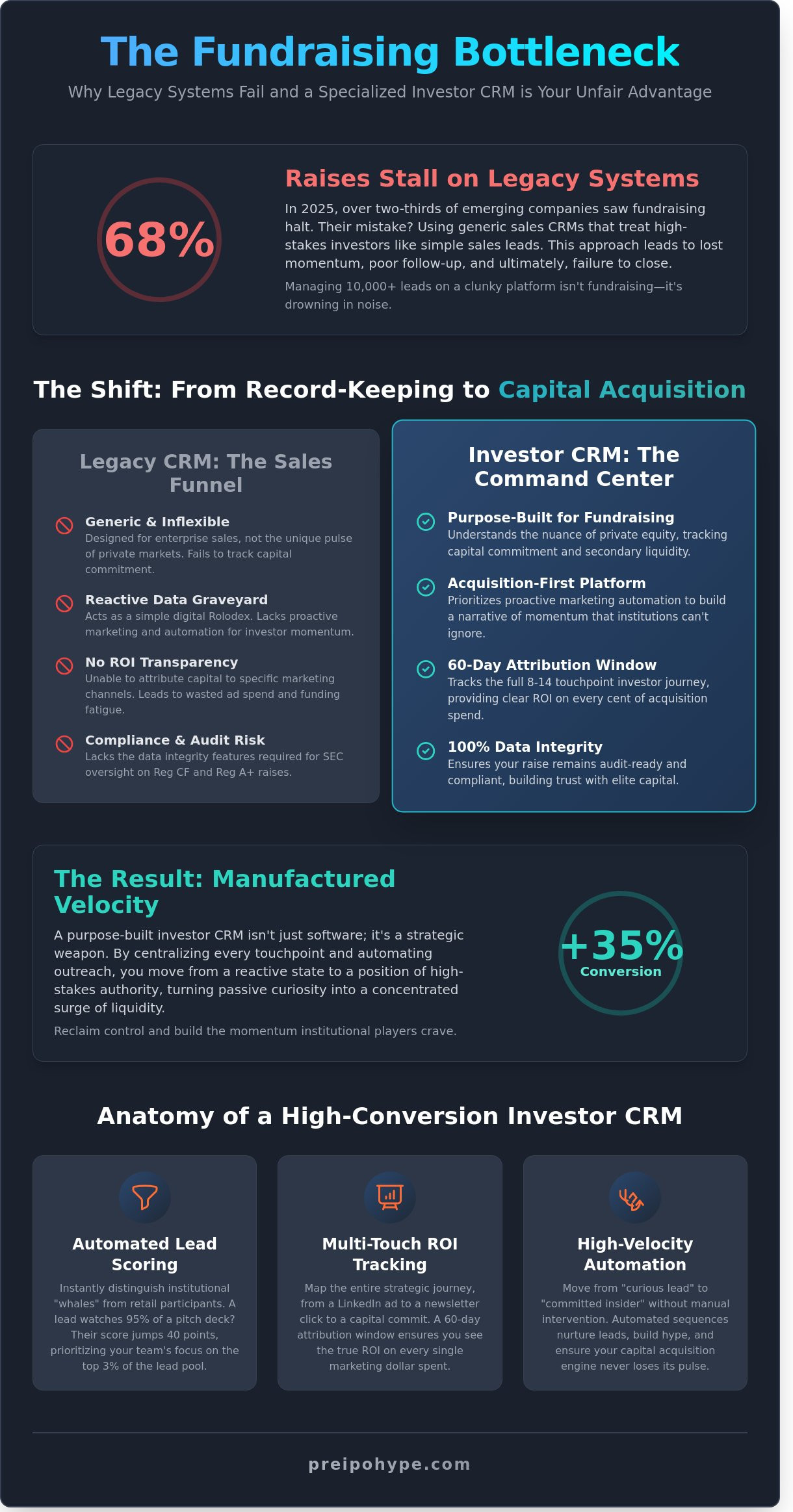
Fundraising is no longer a game of handshakes; it's a game of high-fidelity data architecture. In 2025, 68% of emerging growth companies saw their raises stall because they relied on legacy systems designed for enterprise sales rather than the rapid pulse of private markets. If you're managing 10,000 retail leads through a clunky, generic platform, you aren't fundraising; you're just drowning in noise. A purpose-built investor crm is the only way to reclaim control and turn passive curiosity into a concentrated surge of liquidity.
It's frustrating to watch thousands of potential backers slip through the cracks while you're unable to attribute a single dollar of capital to your specific marketing channels. We understand that in the pre-IPO world, momentum is your most valuable asset. This guide promises to show you how to build a centralized command center that delivers a 35% higher conversion rate and clear ROI tracking on every cent of your acquisition spend. We're breaking down the exact 2026 playbook to manufacture fundraising velocity and secure the ground floor of your next big exit.
Key Takeaways
- Stop treating your raise like a standard sales cycle and learn why a specialized investor crm is the essential command center for navigating high-stakes private market dynamics.
- Master automated lead scoring to instantly distinguish institutional "whales" from retail participants, focusing your energy where capital velocity is highest.
- Identify the critical shift from legacy record-keeping to acquisition-first platforms that prioritize proactive marketing automation and investor momentum.
- Map the strategic journey from "curious lead" to "committed insider" to ensure your capital acquisition engine never loses its pulse.
- Discover how to integrate high-velocity software with a turnkey strategy to manufacture the elite-level hype required for a landmark liquidity event.
What is an Investor CRM and Why Does Your Raise Depend on It?
Detroit founders often treat fundraising as a frantic sprint, yet the elite 5% know it's a calculated data play. Your raise doesn't live in your inbox; it lives in your infrastructure. An investor crm isn't just a digital Rolodex. It's a sophisticated fundraising command center designed to turn cold leads into committed capital. While standard Customer Relationship Management (CRM) systems track simple sales funnels, they lack the nuance required for private equity. An investor crm is a tool that bridges the gap between private secrecy and public opportunity.
To better understand how this infrastructure powers your raise, watch this breakdown:
Generalist tools fail because they don't account for the psychological shifts of a private market raise. You aren't selling a subscription; you're selling a vision of future wealth. This requires a transition from simply managing relationships to acquiring capital at scale. By centralizing every touchpoint, you move from a reactive state to a position of high-stakes authority. It's about building a narrative of momentum that institutional players can't ignore.
The Crucial Difference Between CRM and IRM
In a typical sales cycle, you track Lifetime Value. In fundraising, you track capital commitment and secondary liquidity. The stakes are exponentially higher. You're selling a share of your future, not just a product. Compliance is the invisible wall. In 2025, SEC oversight on Reg CF and Reg A+ raises will demand 100% data integrity to avoid audit triggers. A specialized investor crm ensures your Detroit startup remains audit-ready while courting elite capital.
Why 2026 is the Year of Data-Driven Fundraising
The private market is no longer a closed loop for the institutional elite. In 2026, retail participation in private equity is projected to hit record highs as the democratization of the ground floor accelerates. Market volatility in traditional sectors has pushed hungry investors toward emerging tech hubs. Spreadsheets create funding fatigue. They hide the 42% of leads that go cold due to poor follow-up. Moving to a data-driven system isn't an luxury; it's a survival tactic for those hunting the next unicorn.
The Anatomy of a High-Conversion Investor CRM
A generic CRM is a graveyard for data, but a high-conversion investor crm is a command center for capital. Detroit startups often fail because they treat fundraising like a sales cycle rather than a psychological journey. To win, you need a "Foundation Infrastructure" that bridges your landing pages directly to your pipeline. This setup ensures that every digital footprint is captured, analyzed, and categorized. Understanding Investor Relations 101 is about more than just communication; it's about building a technical framework that validates your legitimacy to high-net-worth individuals from the first click.
Lead Scoring and Investor Segmentation
Not all leads carry the same weight. Your system must automatically distinguish between a retail participant and an institutional whale. We use engagement data to assign scores. If a lead watches 95% of a pitch deck, their score should jump by 40 points. This allows your team to prioritize outreach for high-value targets while automated sequences handle the rest. By utilizing the omnichannel video funnel, you feed the lead engine with pre-qualified prospects. This ensures your fundraising team spends 100% of their time on the top 3% of your lead pool, maximizing every hour spent on the phone.
60-Day Attribution and ROI Transparency
Capital commits rarely happen in 24 hours. The typical investor journey involves 8 to 14 touchpoints over a 60-day window. Your investor crm must track this long-tail curiosity across multiple devices. You need to see when a lead moves from a LinkedIn ad to a newsletter click, and finally to a capital commit. This technical mechanism is the only way to calculate a true Cost Per Acquisition (CPA). When you know that every $500 spent on marketing yields a $25,000 check, you gain the confidence to scale your advertising spend mid-raise. This attribution is the secret weapon for founders who want to move beyond guessing and start executing with precision. If you want to see how this infrastructure fits your specific deal flow, you can ask our CEO for a strategic breakdown of your current funnel.
Investor Management vs. Investor Acquisition Platforms
Most Detroit founders mistake an investor crm for a digital filing cabinet. They assume that as long as they have a place to store contact info, the software is doing its job. This mindset is a relic of the old guard. In the high-velocity world of private equity, your software must be either a defensive shield or an offensive weapon. Choosing the wrong side of that line can stall a Reg A+ or Reg D raise before it even clears the first $500,000 milestone.
Legacy Systems: Built for the Back Office
Institutional-grade platforms like Allvue or enterprise-level Salesforce configurations are designed for stability, not speed. These systems excel at complex cap table management and quarterly reporting for established funds. However, they often function as gated walls for agile startups. Implementation costs for these legacy stacks frequently exceed $65,000 in initial consulting fees alone. They prioritize the "management" of existing capital over the "acquisition" of new wealth. For a Detroit tech firm looking to close a round in 90 days, the administrative bloat of a back-office system becomes a lead weight.
Acquisition Platforms: Built for the Front Lines
Modern acquisition platforms are designed to fuel the hype cycle. They focus on momentum building and the "speed-to-lead" metrics that define successful retail and accredited raises. These systems integrate directly with digital advertising stacks. When a lead clicks an ad, the CRM tracks that attribution with surgical precision. This allows founders to see exactly which creative assets are driving the highest ROI. Compliance is baked into the workflow; your investor crm should automatically provide the client relationship summary (Form CRS) to prospects to ensure transparency while you maintain aggressive outreach cadences.
The platform you choose must align with your specific filing:
- Reg CF: Requires high-volume automation to handle 2,000+ micro-investors without manual intervention.
- Reg D: Needs high-touch "insider" data to track the behavior of accredited whales and family offices.
- Reg A+: Demands a hybrid approach that mirrors a "mini-IPO" with robust marketing automation and institutional-grade reporting.
The "Insider" advantage comes from proprietary data. Generic software stacks give you empty fields. A specialized acquisition platform provides the context. It tells you which investors are currently hunting for Detroit-based exits and which ones are just window shopping. In a market where 82% of startups fail due to lost momentum, having a CRM that acts as an offensive coordinator is the only way to win the ground floor race.
How to Implement Your Investor CRM for Maximum Momentum
Implementing an investor crm isn't just a technical upgrade; it's a strategic deployment of your startup's narrative. Detroit founders often lose 22% of their potential capital simply because they treat their outreach like a blind broadcast rather than a calculated funnel. To capture the energy of the private market, you must transition from static spreadsheets to a dynamic engine that fuels the hype cycle.
- Step 1: Map your investor journey. Track every interaction from the first "curious" click on a social ad to the final "committed" wire transfer.
- Step 2: Clean and migrate your data. According to 2024 industry benchmarks, 18% of founder contact lists contain outdated information that triggers spam filters. Scrub your "insider" network before the raise begins.
- Step 3: Integrate with your crowdfunding portal. Sync your investor crm directly with Wefunder or StartEngine via API to ensure your dashboard reflects real-time contributions.
- Step 4: Set up automated nurture sequences. If a lead hasn't moved in 72 hours, an automated "insider update" can reignite their interest.
- Step 5: Use real-time data to pivot. If your analytics show a 45% drop-off at the valuation slide, change your messaging immediately to address the friction.
Mapping the Investor Journey
Success in the private markets requires identifying key touchpoints before the first dollar is committed. Your CRM should track the first ad interaction, the initial whitepaper download, and every subsequent email open. We recommend creating "whale triggers." These are instant alerts that notify your team when a high-net-worth individual engages with your pitch deck more than three times in a 24-hour window. This level of precision requires a refined narrative. You can ask our CEO about positioning your narrative to ensure these high-value leads don't slip through the cracks.
Automating the 'Hype' Cycle
The psychology of the "ground floor" opportunity relies on perceived momentum. Use your CRM data to feed social proof back to your audience. When 75% of your early-bird allocation is filled, your automated newsletter should broadcast that scarcity immediately. This creates a "limited time" environment that drives commitments from hesitant backers. Short, punchy updates about your latest Detroit-based pilot program or a new strategic partnership keep the energy high. It's about making the act of investing feel like joining an exclusive movement. Don't let the trail go cold; use automated sequences to maintain a steady pulse of opportunity throughout the 90-day raise window.
Ready to turn your network into a high-velocity capital engine? Book a strategy session to optimize your raise.
The Pre-IPO Hype Advantage: Beyond the Software
A tool is only as powerful as the hands that wield it. Most Detroit founders treat an investor crm like a digital Rolodex, a static list of names and emails that sits idle while the market moves. At Pre-IPO Hype, we view software as the engine, not the driver. Our "Foundation" system is a turnkey infrastructure designed for aggressive investor acquisition. We don't just provide a database; we deliver a tactical roadmap that has facilitated over $102.5 million in funding for our partners. We've bridged the gap between complex omnichannel marketing and raw data execution, ensuring that every digital touchpoint serves a singular goal: closing your round.
Our Custom CRM and Omnichannel Mastery
Success in the private markets requires more than just outreach. It requires intelligence. Our system integrates sophisticated lead scoring and attribution into one actionable dashboard. You won't just see who you've emailed; you'll see exactly which high-net-worth individuals have engaged with your deck three times in the last 48 hours. This precision allows your team to focus on the hottest opportunities while our automated sequences nurture the rest.
The Invst Guru newsletter serves as a high-velocity feeder for this ecosystem. It funnels pre-qualified, sophisticated investors directly into your investor crm, creating a self-sustaining cycle of interest and capital. We've engineered this "Foundation" to be the final frontier for startup fundraising. It's a system that turns anonymous traffic into a community of committed backers. By the time you hop on a call, the "hype" has already done the heavy lifting for you.
Taking the Next Step Toward Your Goal
The 2026 private market won't be kind to the hesitant. As secondary liquidity markets evolve, the window for securing elite-tier valuation benchmarks is narrowing. Founders who act decisively will capture the lion's share of available capital; those who wait for "the right time" will find themselves sidelined. It's time to move from curiosity to capital with a partner who understands the mechanics of momentum.
You've built something incredible in Detroit. Now it's time to show the world. Don't leave your fundraising to chance or outdated spreadsheets. We invite you to book a strategic fundraising session to see the Foundation system in action. Let's look at your current data and build a roadmap to your next eight-figure milestone. The "informed insider" advantage is within your reach if you're ready to take it.
Master the 2026 Capital Cycle
Fundraising momentum isn't a stroke of luck. It's a calculated outcome of a high-conversion investor crm. By shifting from simple record-keeping to an acquisition-first mindset, you position your company for the elite liquidity events that define this decade. We've scaled 230+ companies and facilitated more than $100M in funding by treating investor interest as a measurable science. Our proprietary 60-day attribution technology ensures that no lead goes cold and every touchpoint builds the necessary hype for a successful raise. You've seen how the anatomy of a sophisticated platform separates the market leaders from the noise. Now it's time to bridge the gap between private secrecy and public opportunity. The private market remains the final frontier for significant wealth creation, but it requires a guide who understands the rhythm of the hype cycle. Don't leave your valuation to chance when you can manufacture the urgency required to close your round. The next big exit is already in motion.
Ready to manufacture momentum? Book your 30-minute strategic session now.
The future belongs to the decisive.
Frequently Asked Questions
What is the primary difference between a sales CRM and an investor CRM?
A sales CRM manages transactional product cycles, while an investor CRM tracks long-term capital commitments and institutional relationships. Sales tools focus on 30 day conversion windows. In contrast, investor platforms handle 10 year fund lifecycles and complex cap table structures. You need a system that understands the difference between a one time buyer and a recurring partner who holds 5% of your total equity.
Can an investor CRM help with SEC compliance for Reg CF raises?
A specialized investor CRM automates the documentation required for Reg CF raises, which currently have a $5 million annual limit. It creates an immutable audit trail for every communication and investment. This ensures your Detroit startup stays within SEC Rule 227 guidelines. By centralizing 506(c) accredited investor verifications and subscription agreements, you eliminate the 20% risk of manual filing errors that often derail late stage growth.
How does lead scoring work for potential investors?
Lead scoring assigns numerical values to prospects based on data points like past check sizes and content engagement. An investor with an 85% engagement rate on your pitch deck is 4 times more likely to commit than a cold lead. The system tracks how many times a VC opens your 2024 pro forma. This data lets you prioritize the 10 most active leads instead of wasting hours on passive onlookers.
Does an investor CRM integrate with platforms like Wefunder or StartEngine?
Most modern systems integrate directly with Wefunder and StartEngine via API to sync real time backer data. This allows you to pull 2,000 individual investors from a crowdfunding campaign into a single dashboard. You can then segment these users by their investment tier or geographic location. It’s the only way to maintain secondary liquidity momentum once the initial hype of the public raise subsides.
Why is attribution tracking so difficult in investor acquisition?
Attribution is difficult because an investor typically requires 7 to 12 touchpoints across private emails, LinkedIn, and events before signing. Standard cookies don't track a verbal commitment at a Detroit tech mixer. A specialized system maps these offline interactions to your digital funnel. Without this, you lose sight of which 30% of your marketing spend actually drives the $500,000 checks that fuel your expansion.
Is a specialized CRM necessary for a smaller Seed round?
A specialized system is essential for Seed rounds because you must manage a pipeline of at least 150 potential VCs to secure a lead. Managing this volume in a spreadsheet leads to a 40% drop in follow up efficiency. You're building the data foundation for your Series A today. Starting with a professional system signals to institutional partners that your startup is ready for high stakes scale.
How long does it take to set up a custom investor CRM system?
A custom system typically takes 10 to 14 days to fully deploy and integrate with your existing tech stack. This timeframe includes migrating your current cap table and setting up automated workflows for monthly investor updates. By day 15, your team can begin unicorn hunting with a fully optimized pipeline. Rapid deployment ensures you don't lose momentum during the critical first 30 days of your fundraising cycle.
Disclaimer
Educational only. Not investment, tax, or legal advice. Pre-IPO Hype is investor relations infrastructure for Regulation CF and Regulation A+ raises. We are not a broker-dealer, funding portal, or investment adviser, and we do not offer or sell securities or make investment recommendations. Any securities offering is made only by the issuer, through its own offering documents and, where required, a registered intermediary.


